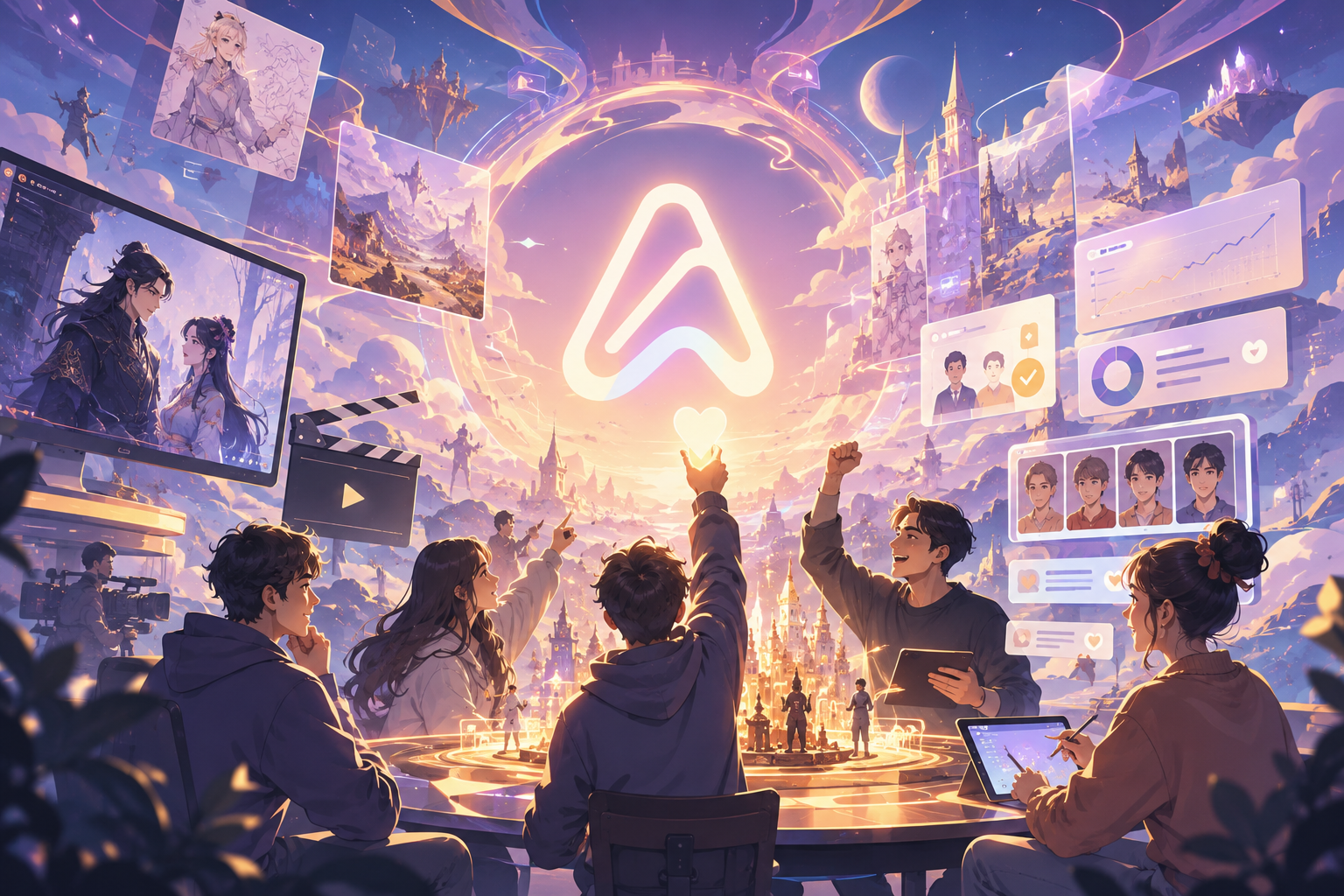
For most of streaming history, audiences have been asked to do one thing: watch after the work is finished.
A film studio develops the idea. A platform licenses or releases it. Viewers arrive at the end of the process, scrolling through a library of completed shows and deciding what deserves an evening of attention.
That model works for mass entertainment. But it leaves a strange gap in the modern creator economy: what happens to the stories that people want to see before a platform decides they are worth making?
ArtForce is built around a different idea. In an AI-powered drama market, the audience can enter earlier. They can discover projects while they are still in development, evaluate the story and creator, subscribe to a project revenue share, join the feedback loop, and help push a story from concept to launch.
That early participant is not just a viewer. On ArtForce, that person is a co-creator.
A co-creator is an early believer in a story
On ArtForce, a co-creator is someone who finds an AI drama project before it is released and chooses to participate in its creation journey.
That participation has three layers:
- Discovery: finding a story, genre, creator, or world that feels worth supporting.
- Participation: joining the project community, following production updates, voting in creator-led decisions, and giving feedback.
- Revenue-share subscription: subscribing to project revenue-share units, so that if the project launches and earns distributable income, the co-creator participates according to the units they hold.
This is why ArtForce describes the role differently from a normal supporter. A supporter helps a project exist. A co-creator helps a project exist, helps shape the momentum around it, and holds a defined connection to its future project revenue.
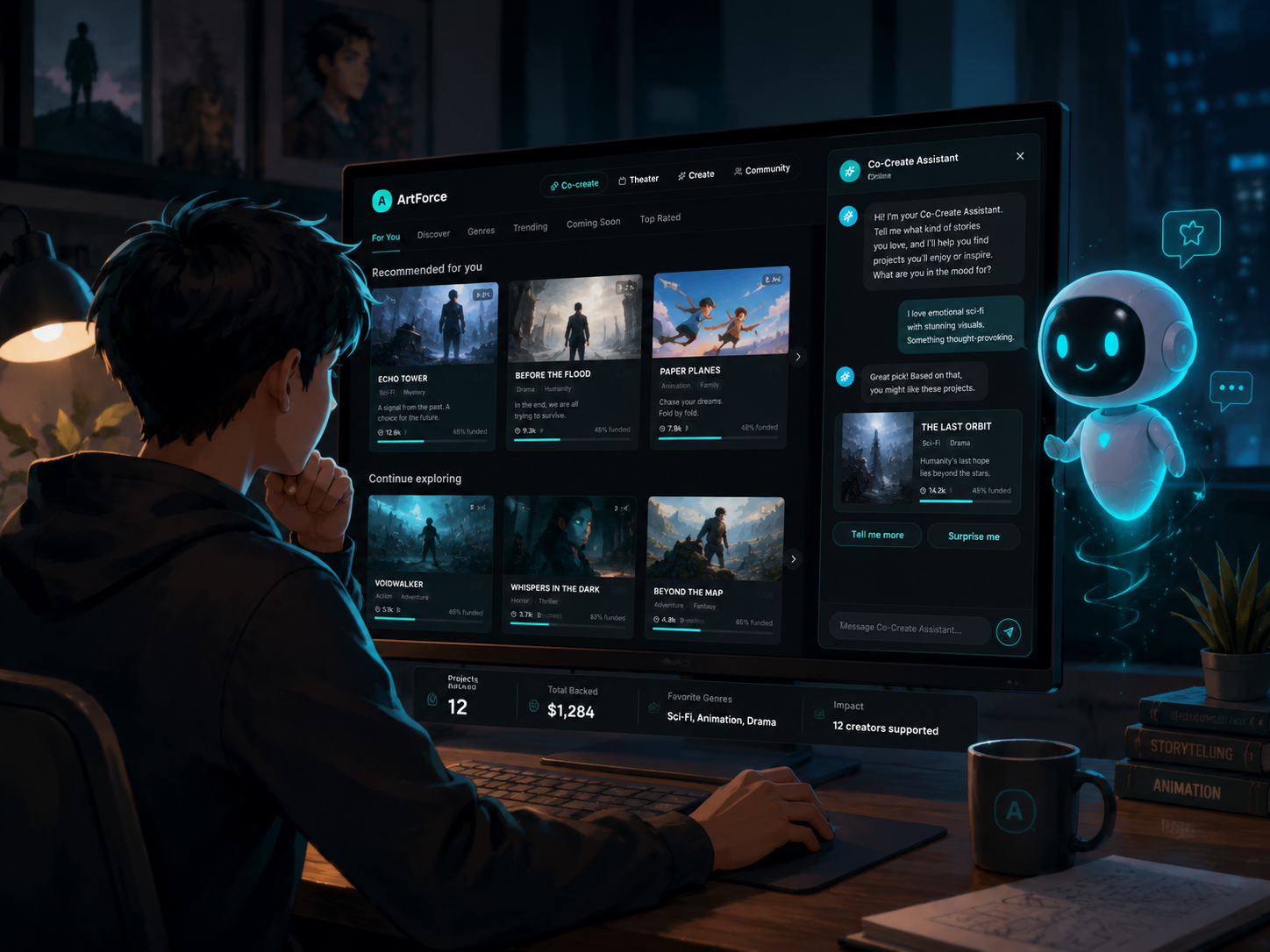
ArtForce starts the journey at project discovery: users can browse in-development AI dramas or ask the Co-Create Assistant to match them with stories they want to watch.
Why this role matters now
AI is changing how visual stories are made. Small teams can now produce concept art, storyboards, animation tests, trailers, character references, and production materials at a speed that would have been unrealistic only a few years ago.
But lower production cost does not automatically create better stories.
Creators still need early validation. They need to know whether a story has an audience before they spend months producing it. Viewers still need a way to express demand for the stories they actually want, especially when those stories are too niche, too strange, too regional, too personal, or too risky for traditional platforms.
The co-creator model connects both sides.
Instead of waiting for finished content to appear in a recommendation feed, audiences can signal demand while the project is still being formed. Instead of guessing what people want, creators can publish a project plan, show the story, disclose the production method, and invite the right community to gather around it.
In other words, ArtForce turns early audience interest into a visible part of the production process.
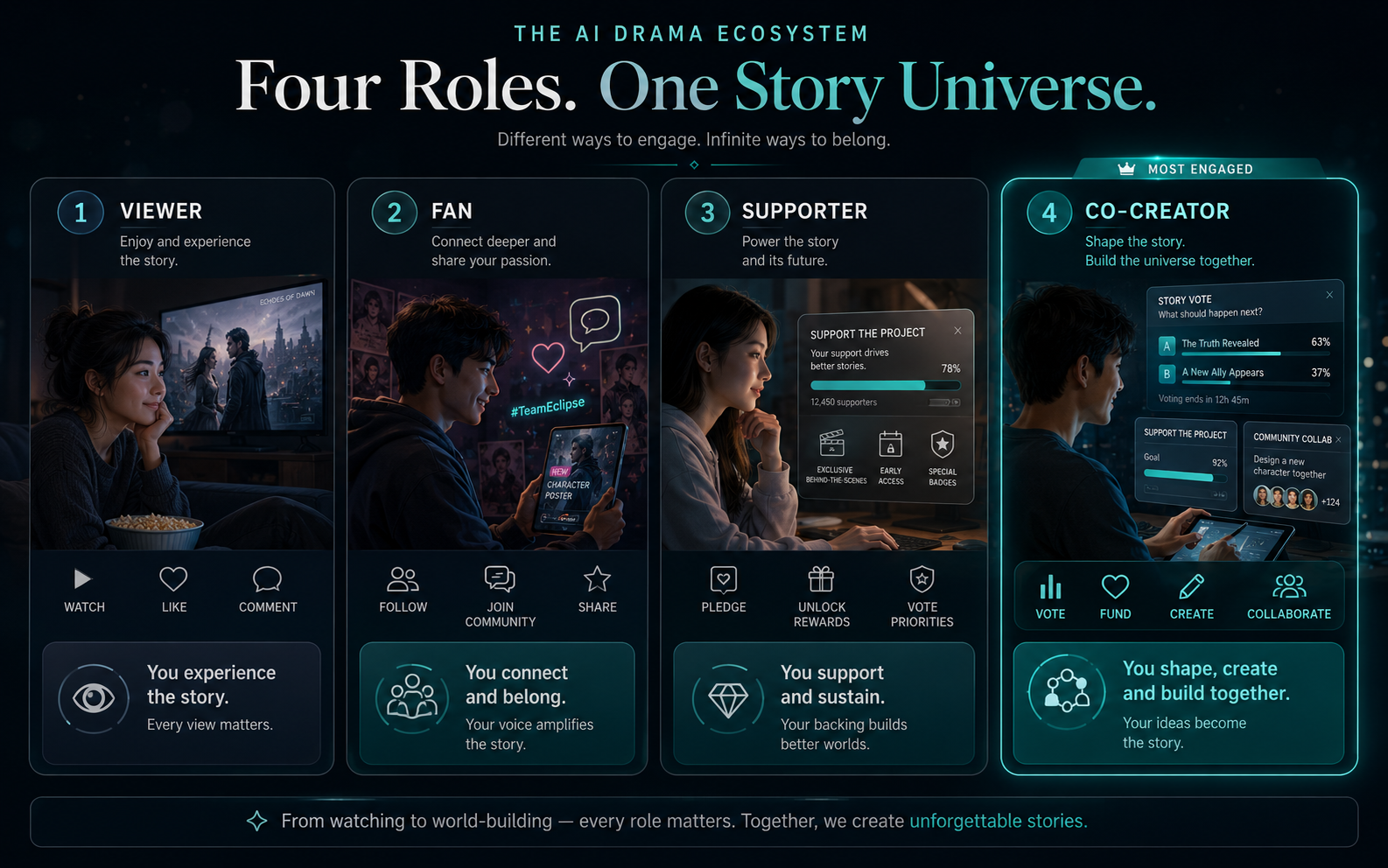
How the co-creator journey works
The ArtForce experience is designed around a simple question: what if a story could find its people before it was made?
Here is the journey in practical terms.
| Stage | What the user does | What ArtForce shows | Why it matters |
|---|---|---|---|
| Discover | Browse AI drama projects or use the Co-Create Assistant | Genre, creator, trailer, project status, funding progress, backer count | Helps users find stories that match their taste before release |
| Evaluate | Open a project detail page | One-line story, synopsis, creator note, dossier, production plan, budget, risks | Turns a story idea into something users can judge seriously |
| Subscribe | Choose a revenue-share unit or custom amount | Unit price, number of units, estimated share, funding goal, remaining time | Makes participation concrete and transparent |
| Participate | Join discussions, votes, updates, and creator feedback loops | Production logs, polls, comments, co-creator identity badges | Gives the audience a voice before the project launches |
| Hold | Follow launch, revenue updates, and future project performance | Project revenue-share records and future liquidity features | Keeps the relationship alive after the first subscription |
The key difference is timing. A normal viewer enters after launch. A co-creator enters before launch.
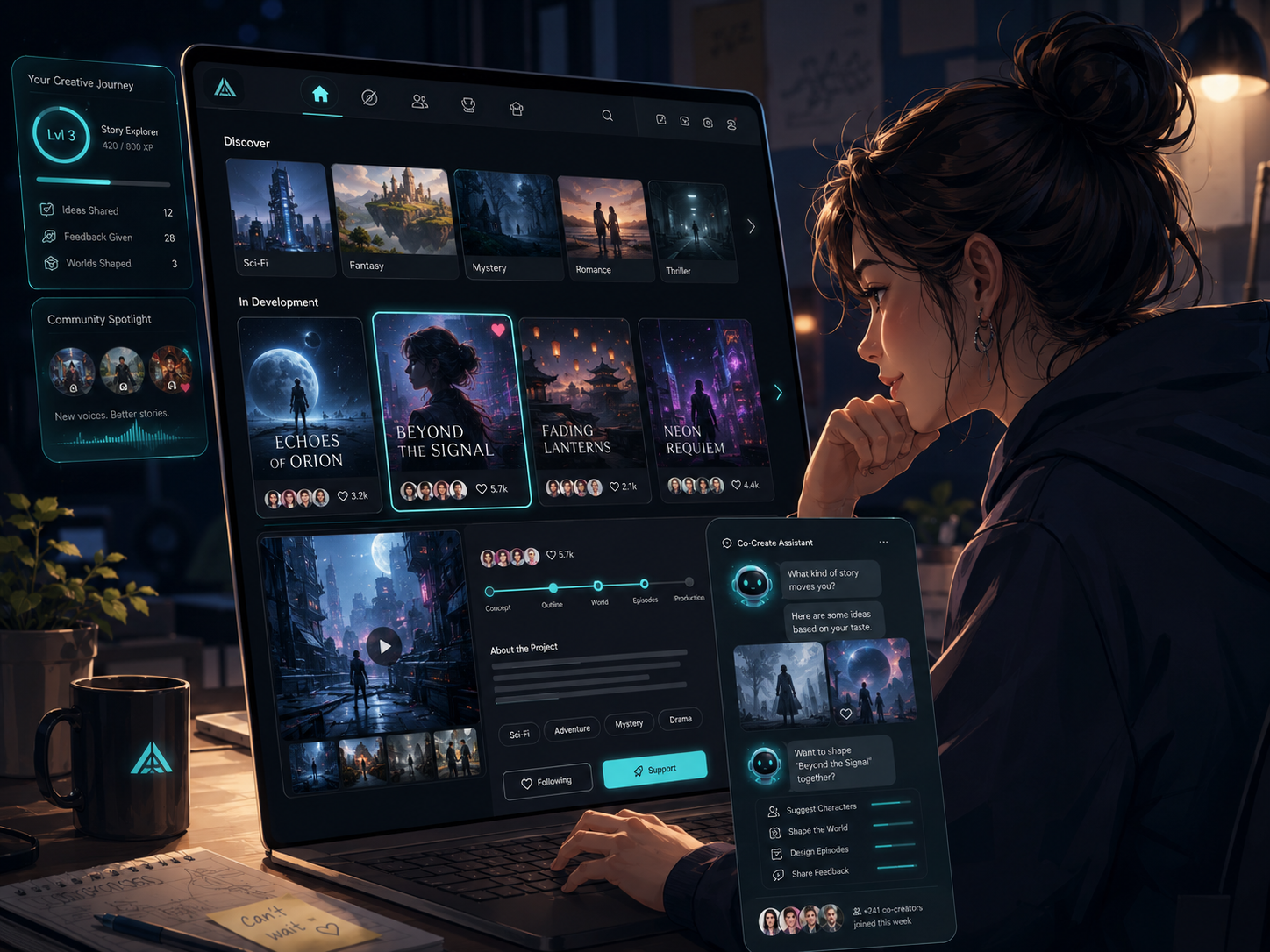
The project page is not just a video page
On a normal streaming platform, a title page is designed to answer one question: do you want to watch this now?
On ArtForce, a project page needs to answer a deeper question: is this story worth helping into existence?
That is why each project page combines creative material with project transparency.
A project detail page combines the emotional hook of a trailer with the practical information co-creators need before subscribing to a revenue-share unit.
A strong ArtForce project page typically includes:
- A one-line story that makes the concept instantly understandable.
- A trailer or concept teaser that shows tone, visual direction, and production ambition.
- A creator note explaining why the creator wants to make the project.
- A story synopsis, world overview, character setting, and visual references.
- A production plan with milestones, delivery expectations, and updates.
- A budget breakdown showing how funds are planned to be used.
- A revenue-share section explaining unit price, total units, progress, and distribution logic.
- Risk disclosures, including delays, project failure, revenue uncertainty, and market limitations.
- A co-creator area for votes, feedback, discussion, and community identity.
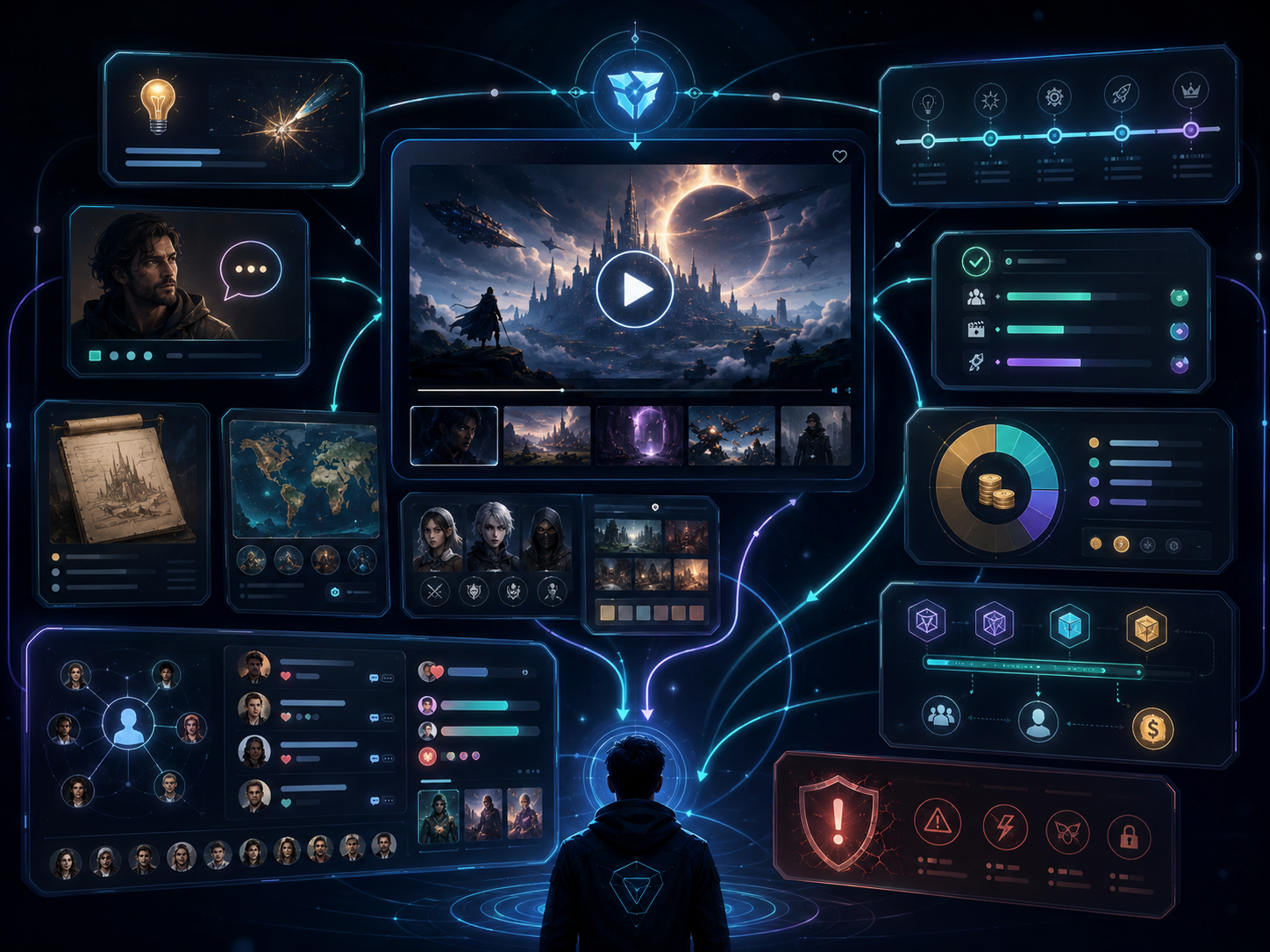
This format makes the project page feel closer to a creative prospectus than a normal entertainment listing. It is still emotional and story-first, but it gives early participants the information they need to make a more thoughtful decision.
What co-creators actually get
The clearest way to understand the role is to separate emotional value from project value.
Emotionally, co-creators get early access to the making of a story. They see how a concept becomes a trailer, how characters evolve, how the creator thinks, and how the community reacts. For fans of niche genres, this is powerful. It allows them to support the exact kinds of stories that usually struggle to survive inside mainstream platform logic.
Practically, co-creators get a project identity and a transparent record of participation. Depending on the project, that may include production logs, community badges, early access, voting rights inside the project community, creator Q&A, and revenue-share units.
Financially, the revenue-share model is designed around project income rather than vague “support rewards.” When a project launches, revenue may come from subscriptions, episode unlocks, merchandise, licensing, or other IP-related channels. After applicable costs and platform rules, distributable project income can be allocated according to the project’s revenue-share structure.
Revenue-share units make participation concrete
Many creative crowdfunding campaigns rely on symbolic rewards: a thank-you note, a badge, a private update, a signed poster. Those rewards can be meaningful, but they usually do not connect the supporter to the long-term performance of the work.
ArtForce adds a different layer: project revenue-share units.
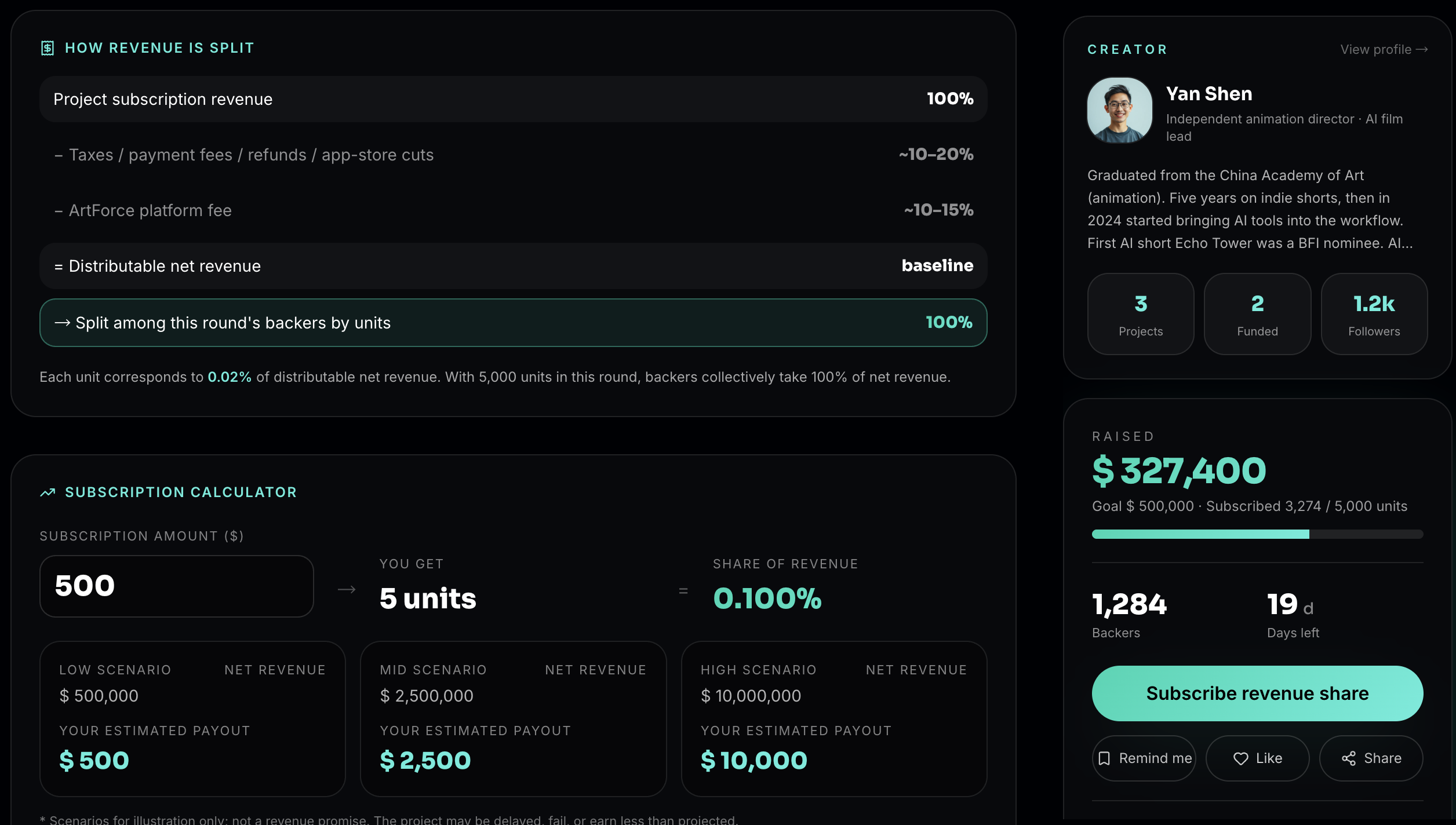
Revenue-share units help users understand the relationship between subscription amount, project units, and participation in future project income.
In plain English, a revenue-share unit is a way to define how a co-creator participates in a project’s distributable income if the project goes live and generates revenue.
The product page should make this easy to understand:
- How much does one unit cost?
- How many total units exist?
- How many units are still available?
- What percentage does one unit represent?
- What happens if the project does not meet its launch threshold?
- What costs are deducted before income is distributed?
- How often are revenue updates shown?
This is where transparency becomes part of the user experience. Co-creators do not need vague promises. They need clear numbers, clear terms, and clear risk language.
Risk disclosure (funding threshold not met): If a project does not reach its funding threshold by the deadline shown on the project page, the creator will notify co-creators that the project is cancelled and eligible co-creators will receive a refund according to the applicable terms. Revenue-share participation is not a guarantee of returns, and a project may be delayed, cancelled, or generate no distributable income.
AI Chat turns audience demand into project supply
One of the most important parts of ArtForce is not only the project page. It is the demand loop.
On a traditional platform, creators publish what they want to make, and the audience decides whether to support it.
On ArtForce, users can also tell the Co-Create Assistant what they want to watch. They can describe genres, emotions, characters, settings, or story styles. If a matching project exists, the assistant can guide them toward it. If not, the platform can record that demand and pass the signal back to creators.
That creates a more AI-native content system:
Audience demand → AI preference capture → creator feedback → project launch → co-creator subscription → production → release → revenue and community feedback.
This loop matters because the future of AI entertainment will not be only about faster production. It will be about better matching between stories and the communities that want them.
Why creators benefit from co-creators
For creators, the co-creator model solves a painful problem: starting too late.
Many creators wait until a finished project exists before they discover whether anyone cares. By then, the budget has already been spent, the creative direction is locked, and the platform has little evidence of demand.
ArtForce lets creators test interest earlier.
A creator can publish a project plan with a one-line story, concept trailer, character setting, production roadmap, and funding target. If people respond, the creator gains more than capital. They gain early audience proof, community language, feedback, and a group of people who are emotionally invested in helping the project succeed.
That early community can influence:
- Which characters audiences care about most.
- Which poster or trailer direction travels better.
- Which plotlines create stronger discussion.
- Which merchandise might be worth producing after launch.
- Which audience segments are most likely to share the work.
The result is not “audience control.” The creator still leads the work. But the work is no longer created in isolation.

The bigger shift: stories as participatory IP projects
The most interesting part of ArtForce is not simply that it uses AI.
The bigger shift is that a story can now behave more like a living IP project.
Before launch, it has a community, funding signal, creator roadmap, and co-creator base. During production, it has updates, votes, and visible progress. After release, it can generate subscriptions, episode unlocks, merchandise sales, licensing opportunities, and potentially secondary-market demand for project revenue-share units.
That is a new kind of entertainment relationship.
A story is no longer only something to watch. It can be something to discover early, help validate, participate in, and follow as an evolving creative asset.
FAQ
What is an AI drama co-creator?
An AI drama co-creator is someone who discovers an AI drama project before it is released and chooses to participate in its early journey. On ArtForce, this can include exploring the story, following the creator’s updates, joining project discussions, voting on selected creator-led decisions, and subscribing to revenue-share units.
Is a co-creator the same as a viewer?
No. A viewer usually watches a finished drama after it is released. A co-creator joins earlier, when the project is still being formed. Instead of only watching the final result, co-creators can help signal demand, follow production progress, and become part of the early community around the story.
Does becoming a co-creator mean I control the story?
No. The creator still makes the final creative decisions. Co-creators can provide feedback, join discussions, and participate in selected votes, but the role is not to replace the creator. The purpose is to help creators understand early audience interest and build momentum around the project.
What happens if a project doesn’t reach its funding threshold?
If a project does not reach its funding threshold by the deadline shown on the project page, the creator will notify co-creators that the project is cancelled. Eligible co-creators will receive a refund according to the applicable terms shown on the project page.
What are revenue-share units?
Revenue-share units are project units that define a co-creator’s participation in a project’s future revenue-share structure. If the project launches and generates distributable net revenue, eligible co-creators may participate according to the number of units they hold and the rules shown on the project page.
Why does ArtForce use a co-creator model?
ArtForce uses the co-creator model because AI makes production faster, but creators still need early audience validation. Co-creation helps users express what they want to watch, helps creators understand real demand before full production, and helps promising stories find the right community earlier.